
Dunstanburgh Castle
Craster, United Kingdom

Freely accessible
Public space — no opening hours to check.
Strollie cannot guarantee access — always check before you travel.
- Opening hours
- Tu-Su 10:00-17:00
- Wheelchair access
- Partly accessible
From OpenStreetMap — confirm before travelling
Find out more
- OfficialOfficial website↗
- Heritage registerHistoric England listing↗
- ReferenceKulturenvanteri↗
- Further readingTripadvisor↗
Dunstanburgh Castle is a 14th-century coastal fortification in Northumberland, England, built by Thomas, 2nd Earl of Lancaster between 1313 and 1322. Strategically positioned on the coast between Craster and Embleton, the castle exploited natural defences and the remains of an Iron Age fort. Intended as a secure refuge amid Thomas's baronial opposition to King Edward II, it also served as a monument to his wealth and power, rivalling the nearby royal castle of Bamburgh. Thomas was captured at the Battle of Boroughbridge in 1322 before he could reach his new fortress and was executed; the castle then passed to the Crown and eventually the Duchy of Lancaster. Defences were expanded in the 1380s by John of Gaunt in response to Scottish threats. Though strategically significant during the Wars of the Roses, Dunstanburgh declined after the 15th century, falling into decay by the 16th century. Sold into private ownership in 1604, the increasingly ruinous castle became celebrated by Romantic artists including Thomas Girtin and J. M. W. Turner, and inspired a poem by Matthew Lewis. After centuries of private ownership, financial constraints led Sir Arthur Sutherland to place it under state guardianship in 1930.
- Built
- Type
- castle, archaeological site
- Heritage
- Grade I listed building, scheduled monument
- Place
- Craster, United Kingdom
This building on
Architecturally similar
 Stafford CastleStafford, United Kingdom
 Wallingford CastleWallingford, United Kingdom
 Dunstaffnage CastleArgyll and Bute, United Kingdom
 Enniskillen CastleEnniskillen, United Kingdom
 Norham CastleNorham, United Kingdom
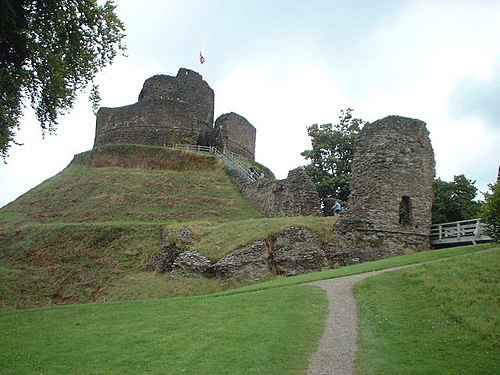 Launceston CastleLaunceston, United Kingdom
 Nunney CastleNunney, United Kingdom
 Northampton CastleNorthampton, United Kingdom
Location