
City of Durham, United Kingdom
Durham Cathedral
City of Durham, United Kingdom

Open to visitors
The interior is normally open, possibly ticketed.
Strollie cannot guarantee access — always check before you travel.
- Wheelchair access
- Partly accessible
From OpenStreetMap — confirm before travelling
Find out more
- OfficialOfficial website↗
- Heritage registerHistoric England listing↗
- ReferenceKulturenvanteri↗
- Further readingEncyclopædia Britannica↗
Durham Cathedral, the seat of the Bishop of Durham and successor to the Anglo-Saxon Lindisfarne Priory, stands in the city of Durham, England. Founded in 1093, a substantial portion of the present Norman structure was completed by 1133, replacing an earlier "White Church" and representing a significant example of Romanesque architecture. The cathedral's nave features the earliest surviving pointed rib vault in England. The Galilee chapel was added in the 1170s, western towers around 1200, and the Early English Gothic east end expanded in the 1230s; a Perpendicular Gothic central tower followed in the fifteenth century. The cathedral houses the shrines of Anglo-Saxon saints Cuthbert and Bede and contains notable medieval and later furnishings including a bishop's throne, Neville screen, Prior Castell's Clock, and seventeenth-century choir fittings by Bishop Cosin. Now a Grade I listed building and part of the Durham Castle and Cathedral UNESCO World Heritage Site, it continues to serve as the mother church of Durham Diocese and receives nearly 400,000 visitors annually.
Movement
- Built
- Type
- organization, Anglican or Episcopal cathedral
- Heritage
- part of UNESCO World Heritage Site, Grade I listed building
- Height
- 22 m
- Place
- City of Durham, United Kingdom
This building on
Architecturally similar
 Peterborough CathedralCity of Peterborough, United Kingdom
 Chichester CathedralChichester, United Kingdom
 Chester CathedralChester, United Kingdom
 Old Sarum CathedralSalisbury, United Kingdom
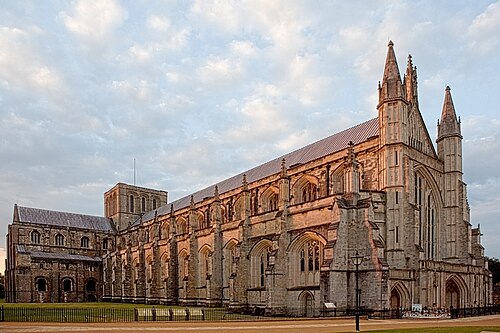 Winchester CathedralWinchester, United Kingdom
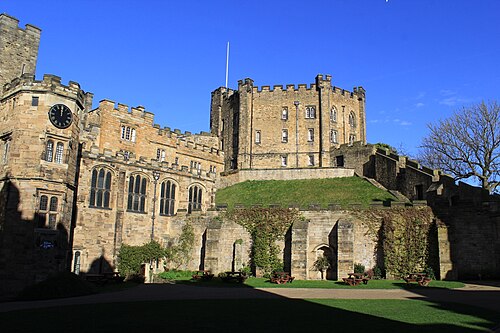 Durham CastleCity of Durham, United Kingdom
 Norwich CathedralNorwich, United Kingdom
 Bristol CathedralEngland, United Kingdom
Location