
Hammond–Harwood House
Annapolis, United States

Open to visitors
The interior is normally open, possibly ticketed.
Strollie cannot guarantee access — always check before you travel.
Find out more
- OfficialOfficial website↗
- Heritage registerNational Register of Historic Places↗
- ReferencearchINFORM↗
- Further readingTripadvisor↗
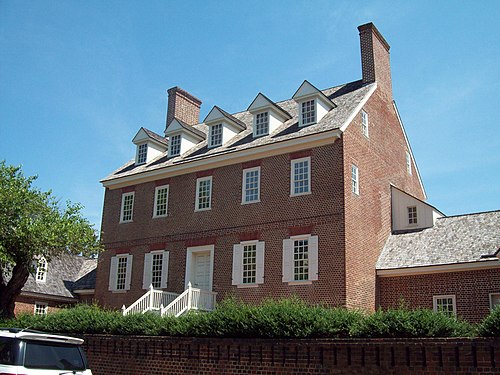
The Hammond–Harwood House, built in 1774 in Annapolis, Maryland, stands as one of America's finest surviving colonial residences and a rare example of domestic architecture directly derived from Andrea Palladio's canonical treatise. Designed by William Buckland for wealthy farmer Matthias Hammond, the brick and wood structure embodies Georgian and Palladian principles, specifically modeled after the Villa Pisani in Montagnana, Italy, as illustrated in *I Quattro Libri dell'Architettura*. Its scholarly adherence to Palladio's proportions and vocabulary makes it one of the only existing works of colonial academic architecture rooted so explicitly in a single architectural plate. Designated a National Historic Landmark in 1960, the house is now operated as a museum by a nonprofit organization, preserving its significance as a testament to eighteenth-century American wealth, taste, and classical learning.
Architect
Movement
- Built
- Type
- single-family detached home, historic house museum
- Materials
- brick, wood
- Heritage
- National Register of Historic Places listed place, National Historic Landmark
- Place
- Annapolis, United States
This building on
Architecturally similar
 Jonathan Hammond HouseWaltham, United States
 Harewood HouseHarewood, United Kingdom
 Paca House and GardenAnnapolis, United States
 Brice HouseAnnapolis, United States
 Col. Benjamin Simond HouseWilliamstown, United States
 Government HouseAnnapolis, United States
 Larkin's HundredAnne Arundel County, United States
 Thomas Atwood HouseWellfleet, United States
Location