
Taliesin
Spring Green, United States

Exterior only
Visible from the street; the inside is private.
Find out more
- Heritage registerNational Register of Historic Places↗
- ReferencearchINFORM↗
- OperatorOperator’s website↗
Taliesin, a 600-acre house-studio complex located 2.5 miles south of Spring Green, Wisconsin, stands as Frank Lloyd Wright's masterwork of Prairie School architecture. Built beginning in 1911 on land near his maternal family's holdings, the estate was designed by Wright in collaboration with Mamah Borthwick after he left his first wife and Oak Park home. The main residence and studio, completed that year, exemplified Prairie School principles through its integration with the landscape—emulating the flatness of the plains and incorporating Wisconsin's natural limestone outcroppings. Named Taliesin, meaning "shining brow" in Welsh, the structure was built into the brow of a hill and eventually encompassed agricultural and studio wings. Two catastrophic fires reshaped the complex: in 1914, after a disturbed employee's arson and murder of Borthwick and six others, Wright rebuilt the residential wing; in 1925, an electrical fire prompted another reconstruction. Wright lost the property to foreclosure in 1927 but recovered it with friends' help the following year. In 1932 he established an architectural fellowship there. From this estate, Wright designed many of his most celebrated works, including Fallingwater and the Guggenheim Museum. A UNESCO World Heritage site and National Historic Landmark, Taliesin remains his principal Wisconsin residence until his death, though he wintered at Taliesin West in Arizona from 1937 onward.
Architect
Movement
- Type
- villa, studio, residenz
- Heritage
- part of UNESCO World Heritage Site, National Register of Historic Places listed place
- Place
- Spring Green, United States
This building on
Architecturally similar
 Taliesin WestScottsdale, United States
 Rollin Furbeck HouseOak Park, United States
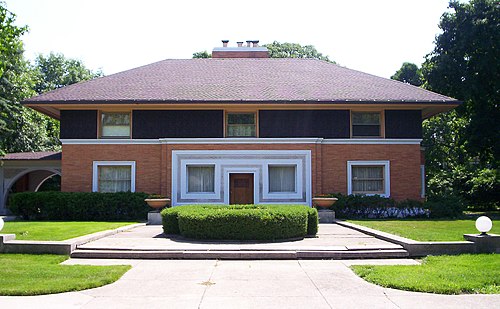 Winslow HouseRiver Forest, United States
 Tan-y-DeriWyoming, United States
 Riverview Terrace RestaurantWyoming, United States
 Frank Lloyd Wright Home and StudioOak Park, United States
 Willits HouseHighland Park, United States
 WingspreadWind Point, United States
Location