
Zwinger
Dresden, Germany

Freely accessible
Public space — no opening hours to check.
Strollie cannot guarantee access — always check before you travel.
- Wheelchair access
- Partly accessible
From OpenStreetMap — confirm before travelling
Find out more
The Zwinger is a palatial complex with gardens in Dresden, Germany, designed by architect Matthäus Daniel Pöppelmann and begun in 1709 as an orangery, garden, and representative festival area. One of the most important Baroque buildings in Germany, it features richly decorated pavilions and galleries lined with balustrades, figures, and vases that reflect the splendor of Augustus the Strong, Elector of Saxony and elected King of Poland. Originally conceived as the forecourt to a new castle, the Zwinger remained incomplete on the Elbe side until architect Gottfried Semper added the Sempergalerie in 1855, a major nineteenth-century German museum project. Extensively damaged during the bombing of Dresden in February 1945, the complex was reconstructed in the 1950s and 1960s and now houses the Old Masters Picture Gallery, the Dresden Porcelain Collection, and the Royal Cabinet of Mathematical and Physical Instruments, establishing it as a premier museum venue alongside being Dresden's most celebrated architectural monument.
Architect
Movement
- Built
- Type
- palace, ruins, construction site
- Heritage
- heritage monument in Saxony
- Place
- Dresden, Germany
This building on
Architecturally similar
 SemperoperDresden, Germany
 Charlottenburg PalaceBerlin, Germany
 Würzburg ResidenceWürzburg, Germany
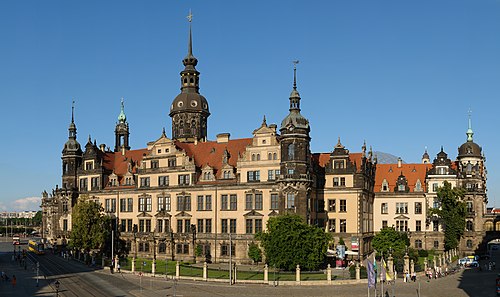 Dresden CastleDresden, Germany
 Opernhaus am ZwingerDresden, Germany
 Leipziger palace in WrocławWrocław, Poland
 Schwerin CastleSchwerin, Germany
 Schwetzingen PalaceSchwetzingen, Germany
Location