
Oranienburg Palace
Oranienburg, Germany

Open to visitors
The interior is normally open, possibly ticketed.
Strollie cannot guarantee access — always check before you travel.
- Wheelchair access
- Partly accessible
From OpenStreetMap — confirm before travelling
Find out more
Oranienburg Palace in Oranienburg, Germany, is the oldest Baroque Schloss in the Margraviate of Brandenburg, built between 1651 and 1655 by Louise Henriette of Orange-Nassau on the site of a former hunting lodge. Designed by architect Johann Gregor Memhardt, the palace drew on Dutch classical architecture, featuring vertical proportions and turrets flanking the side wings. The Electress cultivated an extensive garden devoted to ornamental plants, trees, flowers, and vegetables, introducing potatoes and cauliflower to the region. From 1689, her son Frederick I enlarged the palace and grounds under Italian and French Baroque influence; Johann Arnold Nering led construction until 1699, adding north rear wings with pavilions and a second courtyard, while Johann Friedrich Eosander von Göthe refined the interiors. After Frederick I's death in 1713, the palace declined in use, passing through various hands until 1794, when it became a gift to the future Queen Louise. Subsequently converted into a teachers' seminary (1858–1925), SS barracks (1933–37), and police academy before severe World War II bomb damage, it underwent external restoration from 1948 to 1954. After Soviet occupation, it served as an officer school and Border Troops barracks until 1990, and today operates as a museum.
Architect
- Type
- château
- Heritage
- architectural heritage monument
- Place
- Oranienburg, Germany
This building on
Architecturally similar
 Oldenburg CastleOldenburg, Germany
 Charlottenburg PalaceBerlin, Germany
 LeineschlossMitte, Germany
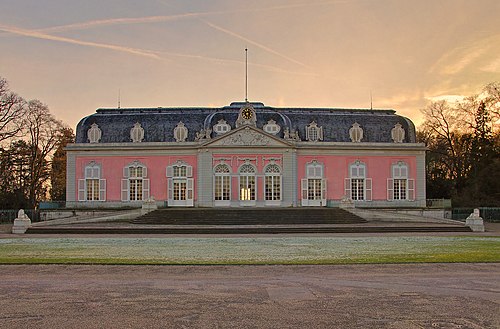 Benrath PalaceDüsseldorf, Germany
 Schloss JohannisbergGeisenheim, Germany
 Jagdschloss GlienickeSteglitz-Zehlendorf, Germany
 Köpenick PalaceTreptow-Köpenick, Germany
 Orangery PalacePotsdam, Germany
Location